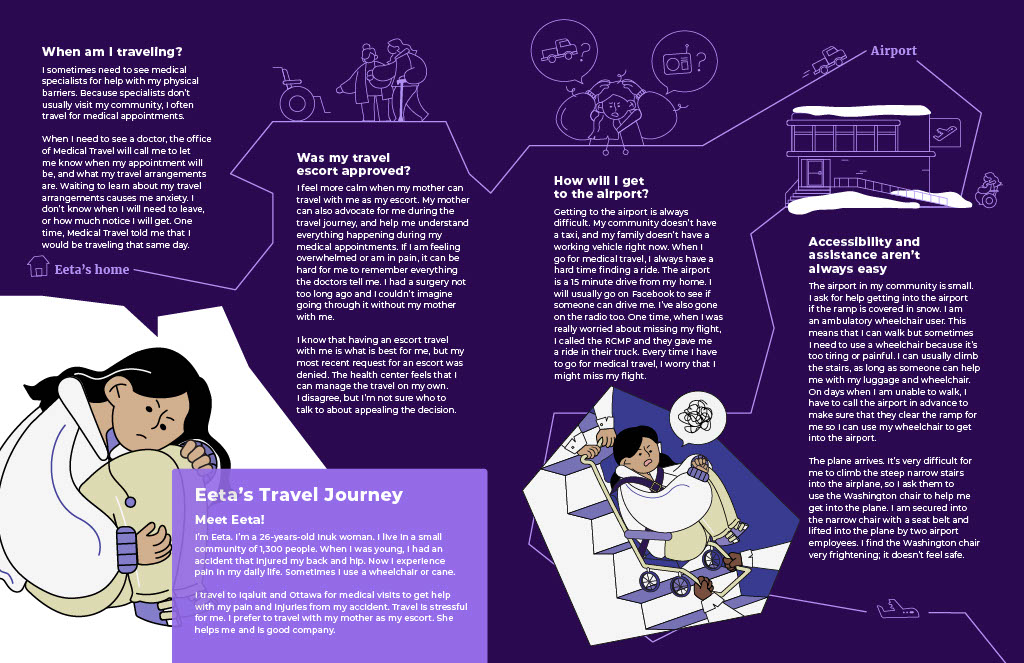
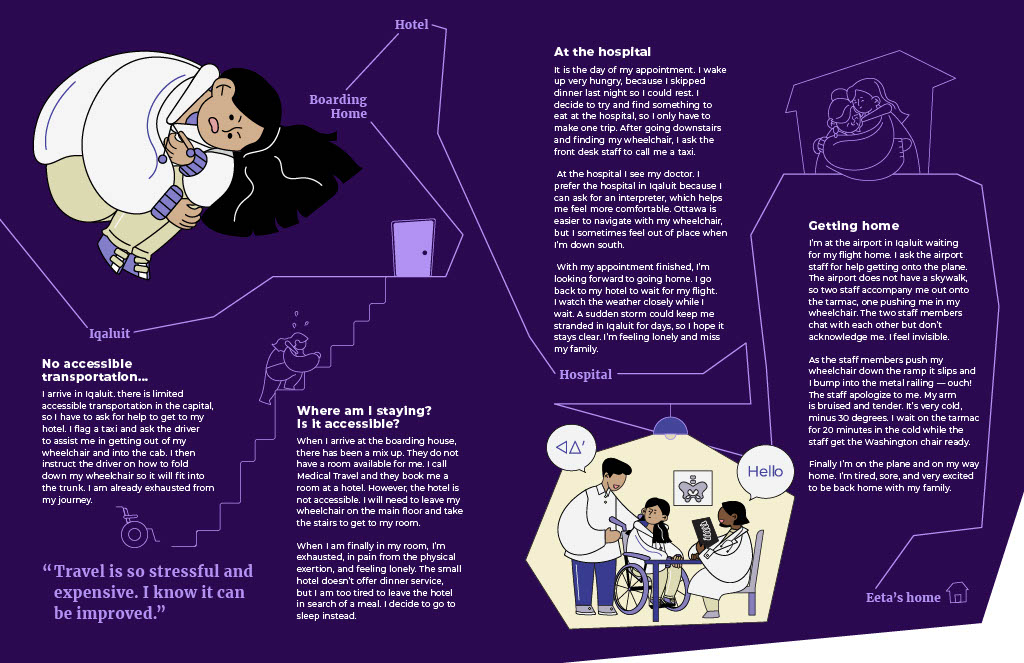
Infographic: ASC Travel Journey


Eeta’s Travel Journey
Meet Eeta!
I’m Eeta. I’m a 26-years-old Inuk woman. I live in a small community of 1,300 people. When I was young, I had an accident that injured my back and hip. Now I experience pain in my daily life. Sometimes I use a wheelchair or cane.
I travel to Iqaluit and Ottawa for medical visits to get help with my pain and injuries from my accident. Travel is stressful for me. I prefer to travel with my mother as my escort. She helps me and is good company.
Quote by Eeta
“Travel is so stressful and expensive. I know it can be improved.”
When Am I traveling?
I sometimes need to see medical specialists for help with my physical barriers. Because specialists don’t usually visit my community, I often travel for medical appointments.
When I need to see a doctor, the office of Medical Travel will call me to let me know when my appointment will be, and what my travel arrangements are. Waiting to learn about my travel arrangements causes me anxiety. I don’t know when I will need to leave, or how much notice I will get. One time, Medical Travel told me that I would be traveling that same day.
Was My Travel Escort Approved?
I feel more calm when my mother can travel with me as my escort. My mother can also advocate for me during the travel journey, and help me understand everything happening during my medical appointments. If I am feeling overwhelmed or am in pain, it can be hard for me to remember everything the doctors tell me. I had a surgery not too long ago and I couldn’t imagine going through it without my mother with me.
I know that having an escort travel with me is what is best for me, but my most recent request for an escort was denied. The health center feels that I can manage the travel on my own. I disagree, but I’m not sure who to talk to about appealing the decision.
How Will I Get to the airport?
Getting to the airport is always difficult. My community doesn’t have a taxi, and my family doesn’t have a working vehicle right now. When I go for medical travel, I always have a hard time finding a ride. The airport is a 15 minute drive from my home. I will usually go on Facebook to see if someone can drive me. I’ve also gone on the radio too. One time, when I was really worried about missing my flight, I called the RCMP and they gave me a ride in their truck. Every time I have to go for medical travel, I worry that I might miss my flight.
Accessibility and Assistance Aren’t Always Easy
The airport in my community is small. I ask for help getting into the airport if the ramp is covered in snow. I am an ambulatory wheelchair user. This means that I can walk but sometimes I need to use a wheelchair because it’s too tiring or painful. I can usually climb the stairs, as long as someone can help me with my luggage and wheelchair. On days when I am unable to walk, I have to call the airport in advance to make sure that they clear the ramp for me so I can use my wheelchair to get into the airport.
The plane arrives. It’s very difficult for me to climb the steep narrow stairs into the airplane, so I ask them to use the Washington chair to help me get into the plane. I am secured into the narrow chair with a seat belt and lifted into the plane by two airport employees. I find the Washington chair very frightening; it doesn’t feel safe.
No Accessible Transportation
I arrive in Iqaluit. there is limited accessible transportation in the capital, so I have to ask for help to get to my hotel. I flag a taxi and ask the driver to assist me in getting out of my wheelchair and into the cab. I then instruct the driver on how to fold down my wheelchair so it will fit into the trunk. I am already exhausted from my journey.
Where Am I Staying? Is It Accessible?
When I arrive at the boarding house, there has been a mix up. They do not have a room available for me. I call Medical Travel and they book me a room at a hotel. However, the hotel is not accessible. I will need to leave my wheelchair on the main floor and take the stairs to get to my room.
When I am finally in my room, I’m exhausted, in pain from the physical exertion, and feeling lonely. The small hotel doesn’t offer dinner service, but I am too tired to leave the hotel in search of a meal. I decide to go to sleep instead.
At the Hospital
It is the day of my appointment. I wake up very hungry, because I skipped dinner last night so I could rest. I decide to try and find something to eat at the hospital, so I only have to make one trip. After going downstairs and finding my wheelchair, I ask the front desk staff to call me a taxi.
At the hospital I see my doctor. I prefer the hospital in Iqaluit because I can ask for an interpreter, which helps me feel more comfortable. Ottawa is easier to navigate with my wheelchair, but I sometimes feel out of place when I’m down south.
With my appointment finished, I’m looking forward to going home. I go back to my hotel to wait for my flight. I watch the weather closely while I wait. A sudden storm could keep me stranded in Iqaluit for days, so I hope it stays clear. I’m feeling lonely and miss my family.
Getting Home
I’m at the airport in Iqaluit waiting for my flight home. I ask the airport staff for help getting onto the plane. The airport does not have a skywalk, so two staff accompany me out onto the tarmac, one pushing me in my wheelchair. The two staff members chat with each other but don’t acknowledge me. I feel invisible.
As the staff members push my wheelchair down the ramp it slips and I bump into the metal railing — ouch! The staff apologize to me. My arm is bruised and tender. It’s very cold, minus 30 degrees. I wait on the tarmac for 20 minutes in the cold while the staff get the Washington chair ready.
Finally I’m on the plane and on my way home. I’m tired, sore, and very excited to be back home with my family.
Infographic